 Rafael Weiss ( Androind Engineer )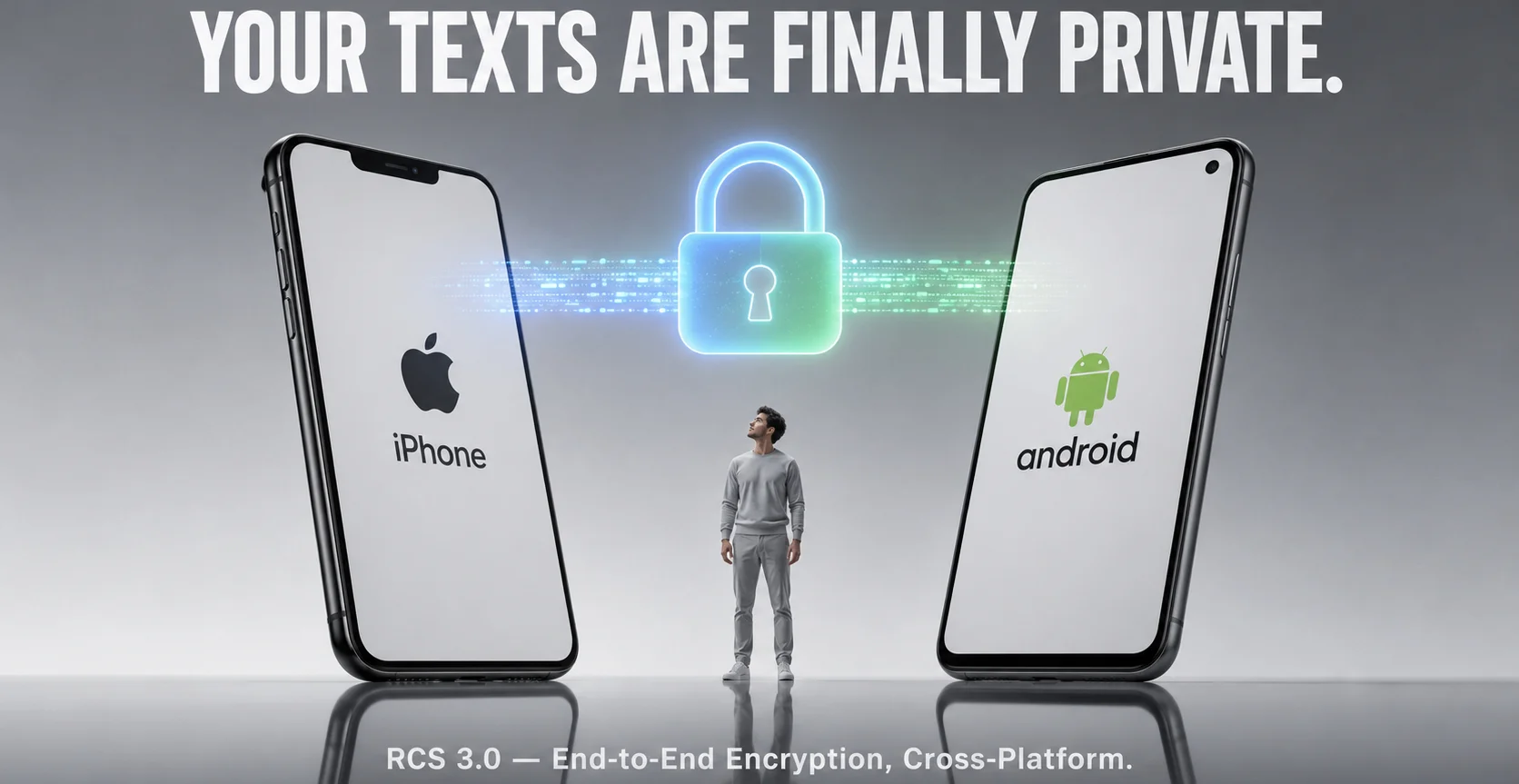
The short version, if you’re in a hurry:
- Cross-platform texting between iPhones and Android phones is now end-to-end encrypted — for the first time ever.
- You need iOS 26.5 (iPhone) and the latest Google Messages (Android) for it to work.
- Your carrier also needs to support RCS Universal Profile 3.0 — most major US carriers already do.
- A lock icon in your chat means the conversation is encrypted. No lock? Still unprotected.
- This closes a security gap that’s existed for over a decade.
The Problem Nobody Talked About Enough
Here’s something that should’ve made more headlines. For years — honestly, well over a decade — every time an iPhone user texted an Android user, that message traveled completely unprotected. No encryption. Readable by your carrier, potentially by law enforcement and yes, by anyone else who managed to get access to the right network infrastructure.
iMessage between two iPhones? Encrypted. Google Messages between two Android phones? Also encrypted, at least since 2021. But the moment those two ecosystems tried to talk to each other, everything fell back to SMS — basically a postcard with no envelope.
This has been flagged by the FBI. CISA flagged this. The FBI even advised people to cease sending unencrypted cross-platform SMS in December 2024, given that it was being exploited in active nation-state attacks. That is not an advisory, it’s a 5-alarm warning.
That gap is now closed. Mostly. Here’s what actually happened.
What Changed in May 2026
Today, Apple and Google released updates that together make it possible for end-to-end encrypted messaging between iPhones and Android phones for the first time. apple’s patch was iOS 26.5. Google’s was an Android stable update to Google Messages.
Both of them would have been unable to accomplish it without the other. This is what people don’t realize. The initial news of Apple’s support for RCS in iOS 18 back in September 2024 was a good start, but it was limited to the older (and unencrypted) RCS Universal Profile 2.4. Google’s own E2EE system was based on the Signal protocol, but could only be used between Google’s own messaging apps.
The technological breakthrough that finally made it possible was a new industry standard, the GSMA Mobile Standards Global body’s (the body that governs mobile standards worldwide) RCS Universal Profile 3.0 that was finalized in March of 2025. It uses an open, interoperable protocol developed by the IETF as it’s encryption backbone, called MLS — Messaging Layer Security. Not Google’s or Apple’s. An area that both sides were able to use as a foundation.
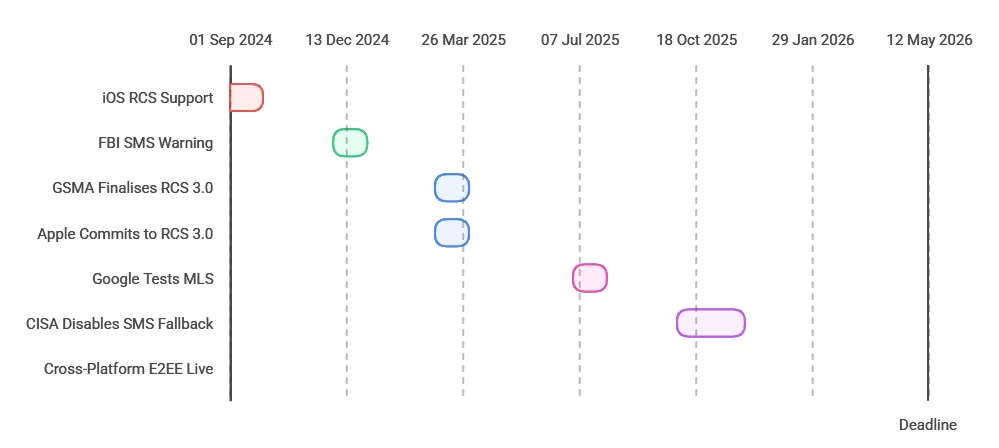
The timeline, laid out cleanly:
| Date | What Happened |
| September 2024 | iOS 18 adds RCS support — but older, unencrypted version |
| March 2025 | GSMA finalizes RCS Universal Profile 3.0 with MLS |
| March 2025 | Apple publicly commits to supporting 3.0 in a future update |
| July 2025 | Google begins testing MLS in Google Messages beta |
| August 2025 | E2EE RCS spotted in iOS 26 beta code |
| February 2026 | iOS 26.4 beta introduces E2EE RCS (Apple-to-Apple only at first) |
| May 11, 2026 | Both Apple and Google release cross-platform E2EE — it’s live |
The Tech Behind It — Without the Headache
You don’t need to understand cryptography for this to matter to you, but a quick comparison helps put it in perspective.
The old RCS was supposed to be encrypted once you sent it between servers but these servers could still read your message; there was what was known as transport-layer encryption. It’s like a sealed truck with your package, but the guys at the warehouse can pop open all boxes. The end-to-end encryption is a different thing. Your message is stored on your device and the key is stored on the recipient’s device. No one in the middle – Apple, Google, your carrier – can read it.
This is made possible because of MLS. Prior to this, Google’s encryption addon used the Signal-protocol but not worked with Apple’s encryption system. The common language they now speak is called MLS.
Here’s how the three messaging types stack up now:
| Feature | SMS/MMS | iMessage (Apple only) | RCS 3.0 (Cross-platform) |
| End-to-End Encryption | ❌ | ✅ | ✅ |
| High-Quality Media | ❌ | ✅ | ✅ |
| Read Receipts / Typing | ❌ | ✅ | ✅ |
| Edit / Unsend Messages | ❌ | ✅ | ✅ |
| Works iPhone ↔ Android | ✅ | ❌ | ✅ |
| Works on Wi-Fi | ❌ | ✅ | ✅ |
RCS 3.0 also adds message editing, unsend and full custom emoji reactions — features that Android users have been waiting on for cross-platform chats specifically.
Does Your Carrier Support It? (Check This First)
Here’s where it gets slightly annoying. The encryption doesn’t just flip on because you updated your phone. Your carrier has to have implemented RCS Universal Profile 3.0 on their end too. All three pieces have to be in place — updated iPhone, updated Google Messages, supported carrier — or the chat stays unencrypted.
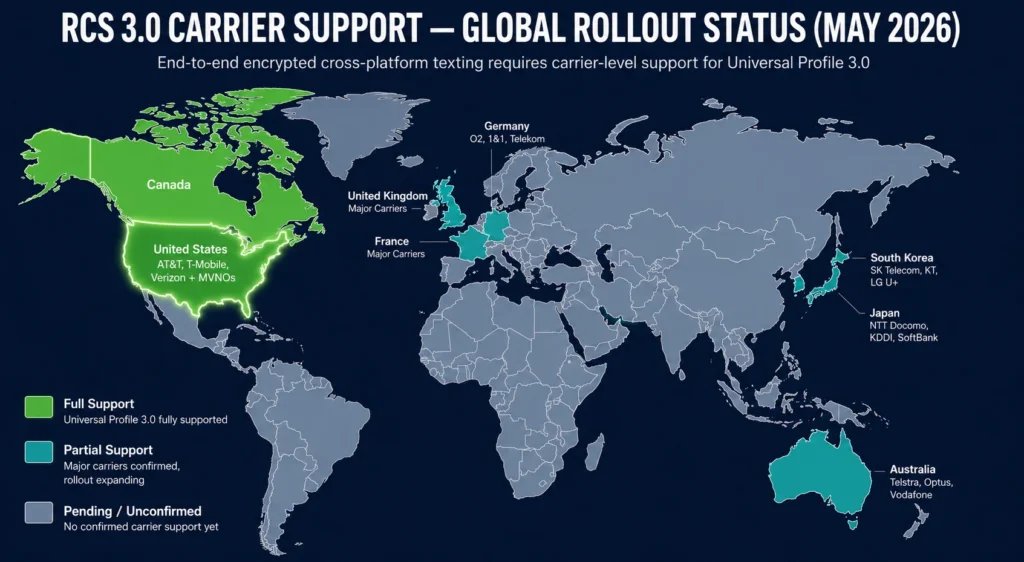
The good news is the major US carriers are already there. As of May 2026:
United States — Confirmed RCS 3.0 Support:
- AT&T
- T-Mobile
- Verizon
- Mint Mobile
- Boost Mobile
- Consumer Cellular
- Cricket
- Metro by T-Mobile
- Spectrum Mobile
- Xfinity Mobile
That covers the vast majority of US subscribers. Canada is also on board and several European carriers — O2, 1&1 and Telekom in Germany specifically — have confirmed support. More are expected through the rest of 2026.
If your carrier isn’t on that list yet, your cross-platform chats will still fall back to regular unencrypted RCS or SMS. Not ideal, but you’ll know — because the lock icon won’t appear.
One thing worth knowing: you can check your specific carrier’s status on Apple’s support page directly. That list will update as more carriers come online and honestly it’s worth bookmarking if you’re on a smaller regional carrier.
The Government Warnings That Led Here
This didn’t happen in a vacuum. The May 2026 update is, in a real sense, a direct response to a string of increasingly urgent government warnings that started picking up steam in late 2024.
December 2024 — the FBI told Americans flat out: stop texting cross-platform over SMS. This came on the back of confirmed nation-state attacks, specifically foreign state-sponsored hackers actively targeting unencrypted SMS and RCS traffic. The FBI doesn’t usually tell people to change how they text. That one landed differently.
Then in October and November 2025, CISA went further. They specifically called out iPhone users, recommending they disable the SMS fallback option in the Messages app entirely — essentially saying even having SMS as a backup option was a security risk. Their guidance pointed people toward Signal or WhatsApp in the meantime.
This is important because it suggests that this isn’t simply a feature the users demanded on Android devices and wanted blue bubbles. A real, proven security flaw was in use. The workarounds were being used for the infrastructure level fix that will be released in May 2026.
What the FBI warning looked like in practice — they weren’t vague about it. Cross-platform SMS traffic was readable. Foreign actors had access. The solution was always going to be encryption at the protocol level and that’s exactly what RCS 3.0 delivers.
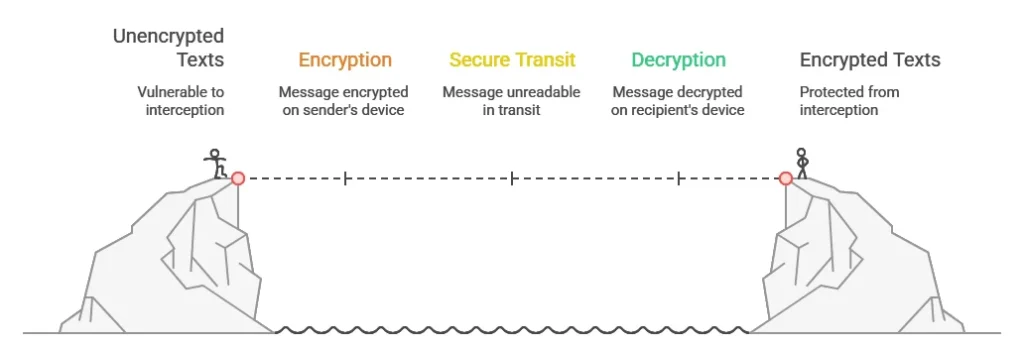
Worth noting though and security analysts are pretty clear on this — E2EE solves the interception problem. It doesn’t solve everything. A message that arrives encrypted but contains a malicious phishing link is still dangerous once you open it. The encryption protects transit. What happens on your screen is still on you.
How to Actually Check If Your Chats Are Encrypted
Knowing the update exists is one thing. Knowing whether your specific conversations are encrypted is another.
Here’s what to look for and what to do:
If you’re on iPhone:
- Update to iOS 26.5 or later — Settings → General → Software Update.
- Open a conversation with an Android contact in the Messages app.
- Look for a lock icon near the message field or an “Encrypted” label at the top of the chat.
- No lock = not yet encrypted (likely a carrier issue on one end).
If you’re on Android:
- Make sure Google Messages is fully updated — open the Play Store and check for updates.
- Open a conversation with an iPhone contact.
- Same deal — look for the lock icon in the chat interface.
- You can also tap the contact name at the top to see connection details.
What if the lock isn’t showing?
A few possible reasons:
- Your carrier hasn’t rolled out RCS 3.0 yet.
- The person you’re texting hasn’t updated their software.
- RCS itself isn’t enabled on one of the devices.
The fallback is still SMS or unencrypted RCS in those cases — which means for genuinely sensitive conversations, dedicated apps like Signal still make sense. Signal offers extra layers like disappearing messages and verified contact identities that RCS 3.0 doesn’t have. WhatsApp also works cross-platform with E2EE. These aren’t being made obsolete by this update — they’re just no longer the only option.
What’s Coming Next: RCS 4.0 Is Already Finalized
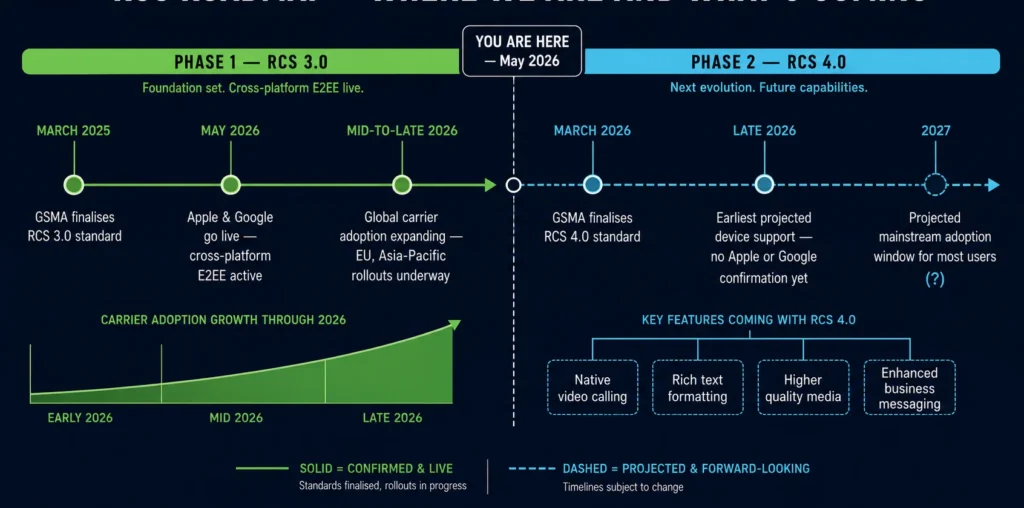
So 3.0 is just fresh off the press and the GSMA has already released the next one. In March 2026, RCS Universal Profile 4.0 was finalized, just a month before 3.0 was even completely on devices. These standards bodies operate as is, ahead of implementation.
What’s in 4.0:
- Native video calling directly from the messaging app — no switching to FaceTime or Google Meet, just call from the same chat thread.
- Rich text formatting — bold, italics, strikethrough, the stuff you’d expect from any modern messaging app.
- Higher quality media sharing — already better in 3.0 than SMS, but 4.0 pushes it further.
- Enhanced business messaging — more structured interactions with companies, think boarding passes, order tracking, that kind of thing built into the message thread.
Sounds good. Catch is — neither Apple nor Google has announced when they’re actually supporting it. Given that 3.0 carrier adoption is still in it’s early months globally, most analysts aren’t expecting 4.0 to be widely available before late 2026 at the earliest, probably pushing into 2027 for most users.
The video calling piece is the one worth watching. If it works cleanly across platforms — iPhone calling Android straight from Messages — that’s a genuinely big deal. FaceTime being Apple-only has been a friction point forever. Whether carriers can handle the infrastructure for that at scale is a different question, but the standard is there.
Practical Steps — What You Should Actually Do Right Now
No long checklist. Just the things that actually matter:
- Update your software. iOS 26.5 on iPhone, latest Google Messages on Android. That’s the baseline. Nothing else in this article matters if you skip this.
- Check your carrier. If you’re on one of the major US carriers listed earlier — AT&T, Verizon, T-Mobile and their subsidiaries — you’re almost certainly covered. Smaller regional carriers, check Apple’s support page. It’s being updated as carriers come online.
- Look for the lock. Seriously, just look. Open a cross-platform conversation and see if the lock icon is there. That’s your real-world confirmation that everything is working end to end, not just in theory.
- Don’t abandon Signal for sensitive stuff. This is important. RCS 3.0 E2EE is a massive improvement over what existed before — but Signal still does things RCS doesn’t. Disappearing messages. Verified contact identities. No carrier dependency. If you’re a journalist, a lawyer, someone handling genuinely sensitive communications — keep using Signal. For everyday texting with family and friends across platforms, RCS 3.0 is now perfectly solid.
- Stay sharp about smishing. Encryption protects the message in transit. A phishing link that arrives in an encrypted message is still a phishing link. The FBI and CISA warnings about social engineering haven’t gone away just because the pipes are now secure. Be as skeptical of unexpected links in texts as you’ve ever been — maybe more so, because people tend to let their guard down when they feel like a platform is “safe.”
Conclusion
This is genuinely one of the more significant mobile security updates in a long time. Not because it’s flashy — most users will just see a small lock icon and move on — but because of what it quietly fixes. A decade-plus vulnerability, flagged by the FBI, exploited by foreign state actors, affecting essentially every cross-platform text conversation anyone ever had. That’s now closed, at least for users on supported carriers with updated software.
The rollout isn’t complete globally. Carrier adoption is still expanding. RCS 4.0 is on the horizon with features that could push things even further. But the foundation — the MLS protocol, the GSMA standard, Apple and Google finally speaking the same encryption language — that’s in place now.
Update your phone. Check the lock. And maybe appreciate that your texts to iPhone users are finally, actually private.